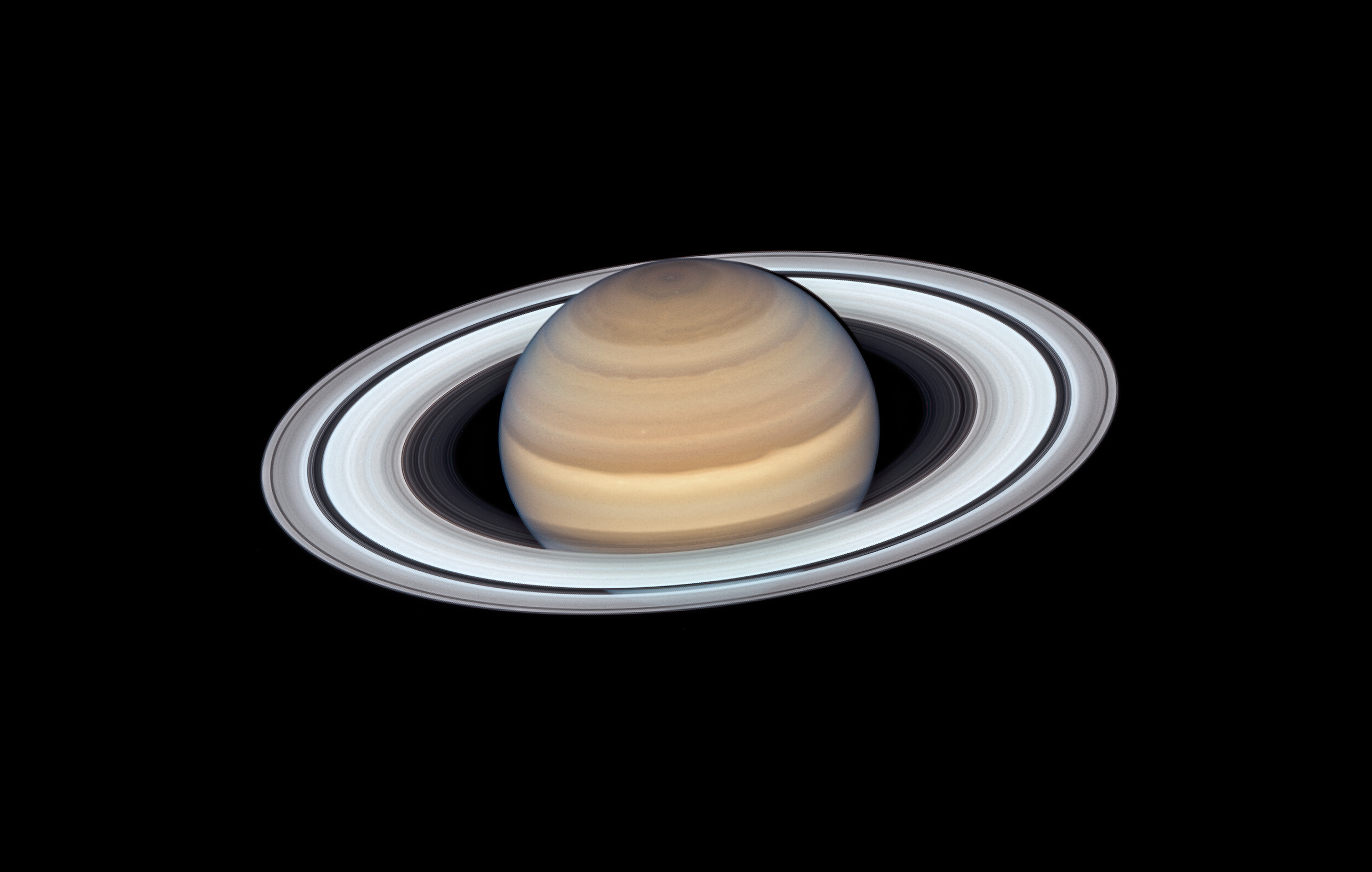
Jupiter
Jupiter is the largest planet in the Solar System, with a mass more than twice that of all other planets combined. Its banded atmosphere of alternating light zones and dark belts is driven by powerful jet streams that encircle the planet parallel to its equator.
The Great Red Spot — Jupiter’s most iconic feature — is a persistent anticyclonic storm that has been continuously observed for at least 350 years. At its current size, the storm spans roughly 1.3 Earth diameters, though it has been contracting over the decades and is considerably smaller than historical measurements.
Hubble’s annual OPAL observations capture the dynamic evolution of Jupiter’s atmosphere: the rise and fall of cloud systems, the appearance and disappearance of smaller storm systems, the temporary fading of cloud belts (known as “belt revival” events), and the complex interactions between the Great Red Spot and nearby vortices.
Jupiter’s four largest moons — Io, Europa, Ganymede, and Callisto — are sometimes visible in wider-field images or captured during transits across the planet’s disk.