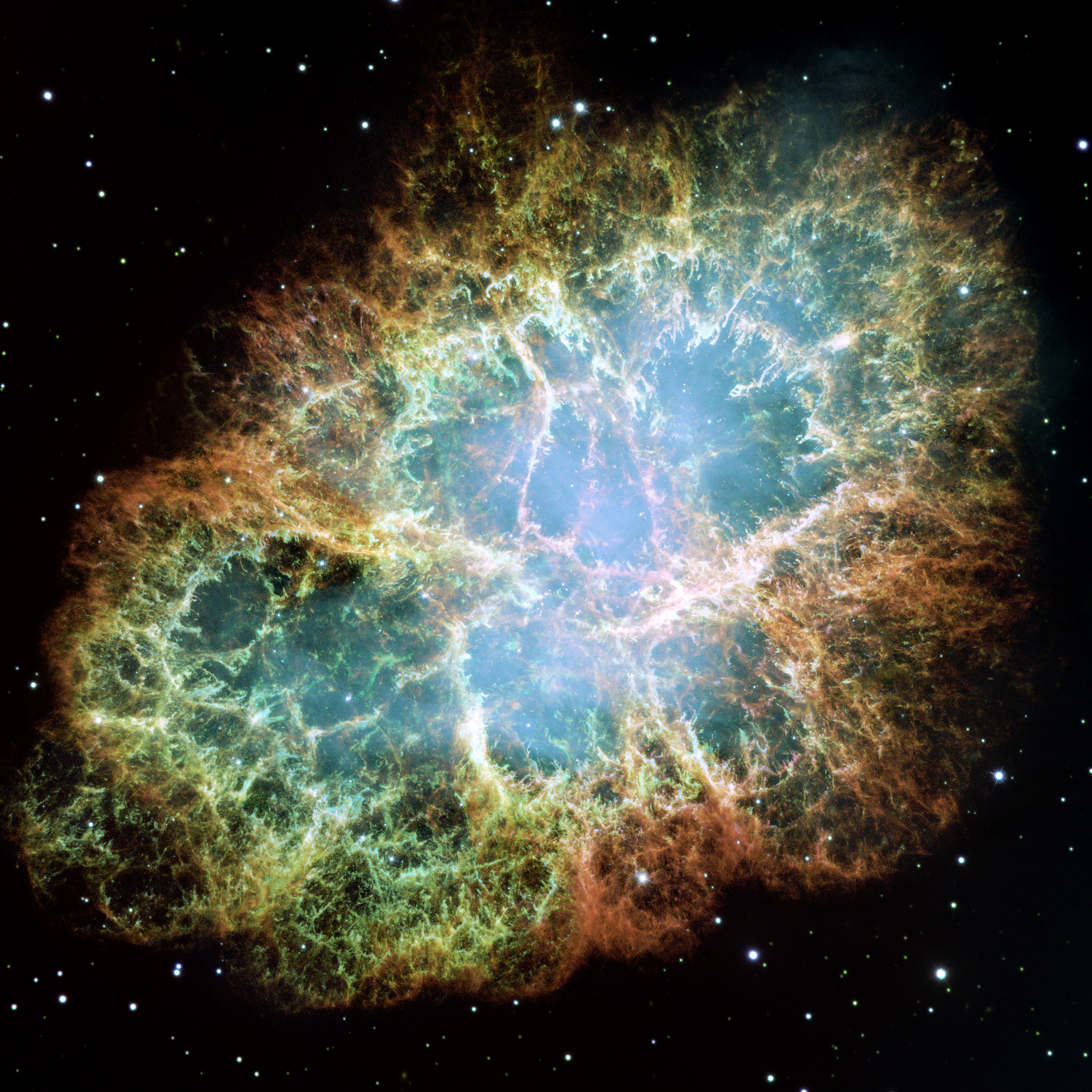
Crab Nebula
The Crab Nebula is the remnant of a supernova explosion witnessed and recorded by Chinese and Arab astronomers in July 1054. At its peak, the supernova was visible in daylight for 23 days. Today it remains one of the most intensely studied objects in the sky.
At the core of the nebula lies a pulsar — a rapidly rotating neutron star only about 28–30 km in diameter, spinning at 30.2 times per second. The pulsar emits beams of radiation that sweep space like a cosmic lighthouse. It is the primary energy source for the entire nebula, injecting high-energy electrons into the surrounding gas through its powerful magnetic field and wind.
The inner blue glow is synchrotron radiation — emitted when electrons spiral through magnetic field lines at near-light speeds. The outer filaments of red and yellow are supernova ejecta consisting of hydrogen, helium, carbon, oxygen, nitrogen, neon, and iron — elements synthesized in the star’s core and scattered by the explosion.
The nebula is expanding at roughly 1,500 km/s and currently spans about 11 light-years, growing measurably in size from one observation to the next.