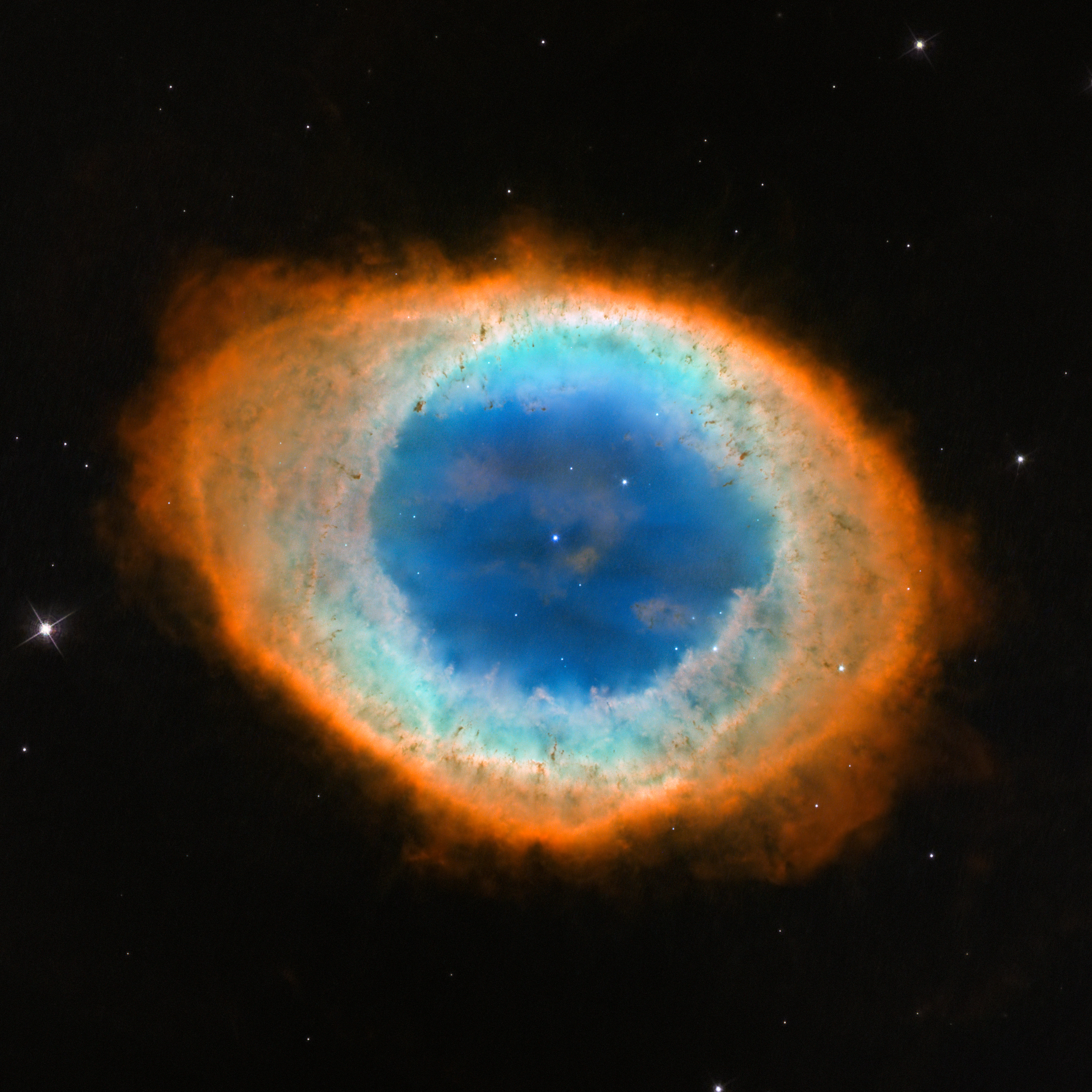
Ring Nebula
The Ring Nebula is one of the most recognized planetary nebulae in the sky — a glowing shell of gas expelled by a dying star. Despite the name, planetary nebulae have nothing to do with planets; the term was coined by 18th-century astronomers who thought their round appearance resembled planet disks through early telescopes.
The white dwarf at the center — what remains of the star that created the nebula — is visible as a faint blue dot. It is roughly the size of Earth but contains roughly 60% of the Sun’s mass, making it extraordinarily dense. The intense ultraviolet radiation it emits ionizes the surrounding gas, causing it to glow.
The colors represent different chemical layers in the expanding shell: the inner blue region is hot oxygen gas, the yellow-green middle region is hydrogen, and the outer red fringe is cooler nitrogen and hydrogen. The shell is expanding at roughly 20–30 km/s.
What appears as a simple ring is actually a complex three-dimensional structure — more barrel-shaped than toroidal, with intricate inner knots and radial filaments. The true shape became clearer with HST observations that allowed detailed 3D modeling.