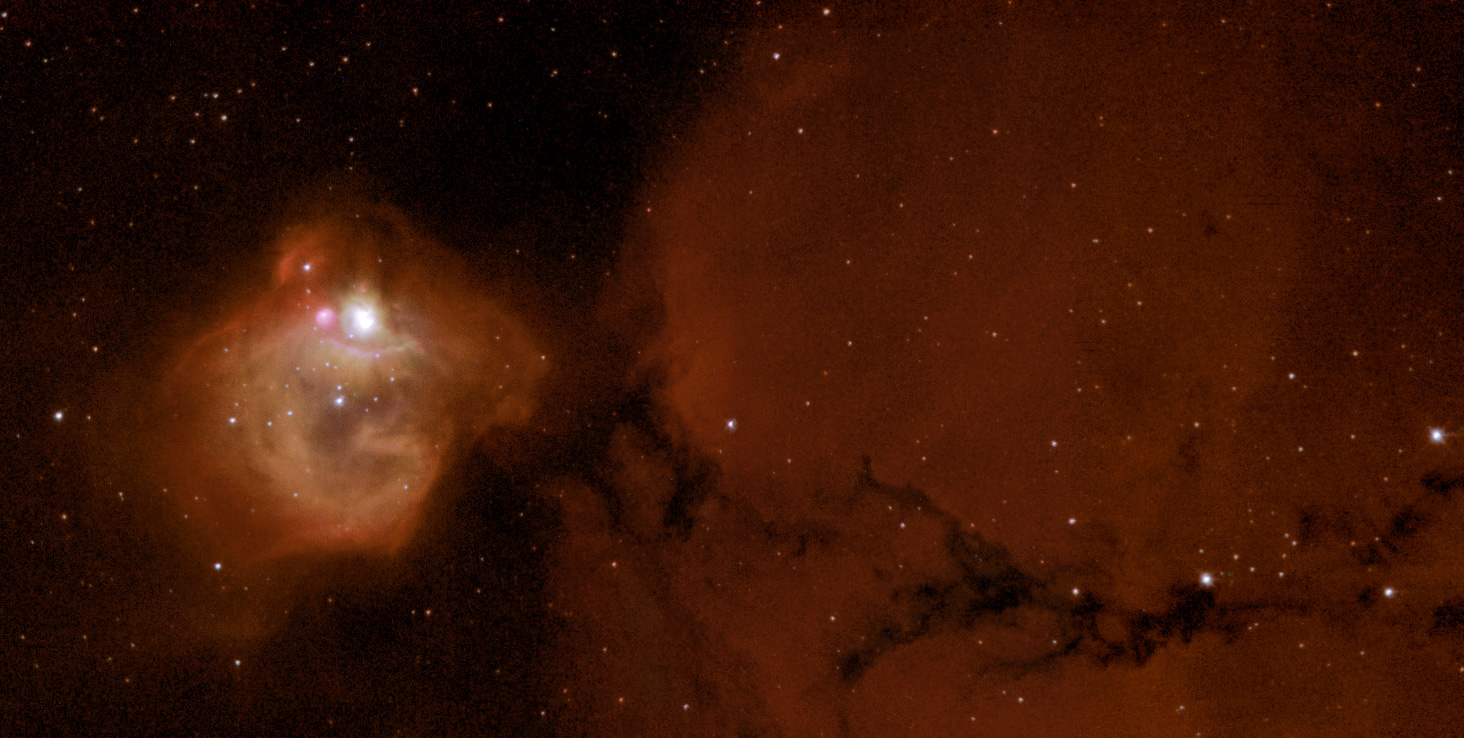
Rosette Nebula
The Rosette Nebula is a large circular emission nebula enclosing the young open star cluster NGC 2244 at its center. The cluster’s hot massive stars, formed roughly 4 million years ago, have blown a cavity in the surrounding molecular cloud through their stellar winds and ultraviolet radiation, creating the characteristic ring shape.
The central cavity spans roughly 30 light-years across. The inner edge of the nebula glows brilliantly where the ionization front meets the denser surrounding molecular material. Beyond the ionized shell, cold molecular gas continues outward for tens of light-years, invisible at optical wavelengths but detectable in radio.
Hubble imaging of the Rosette’s inner regions reveals dense globules — dark, compact clouds of gas and dust that have survived the ionizing radiation. Some of these globules contain protostars; the radiation pressure is compressing them and may be triggering a new round of star formation within the cloud. This process, called radiation-driven implosion, may be common in star-forming regions throughout the galaxy.
The nebula spans roughly 130 light-years in diameter and contains enough material to form several thousand solar masses of stars.