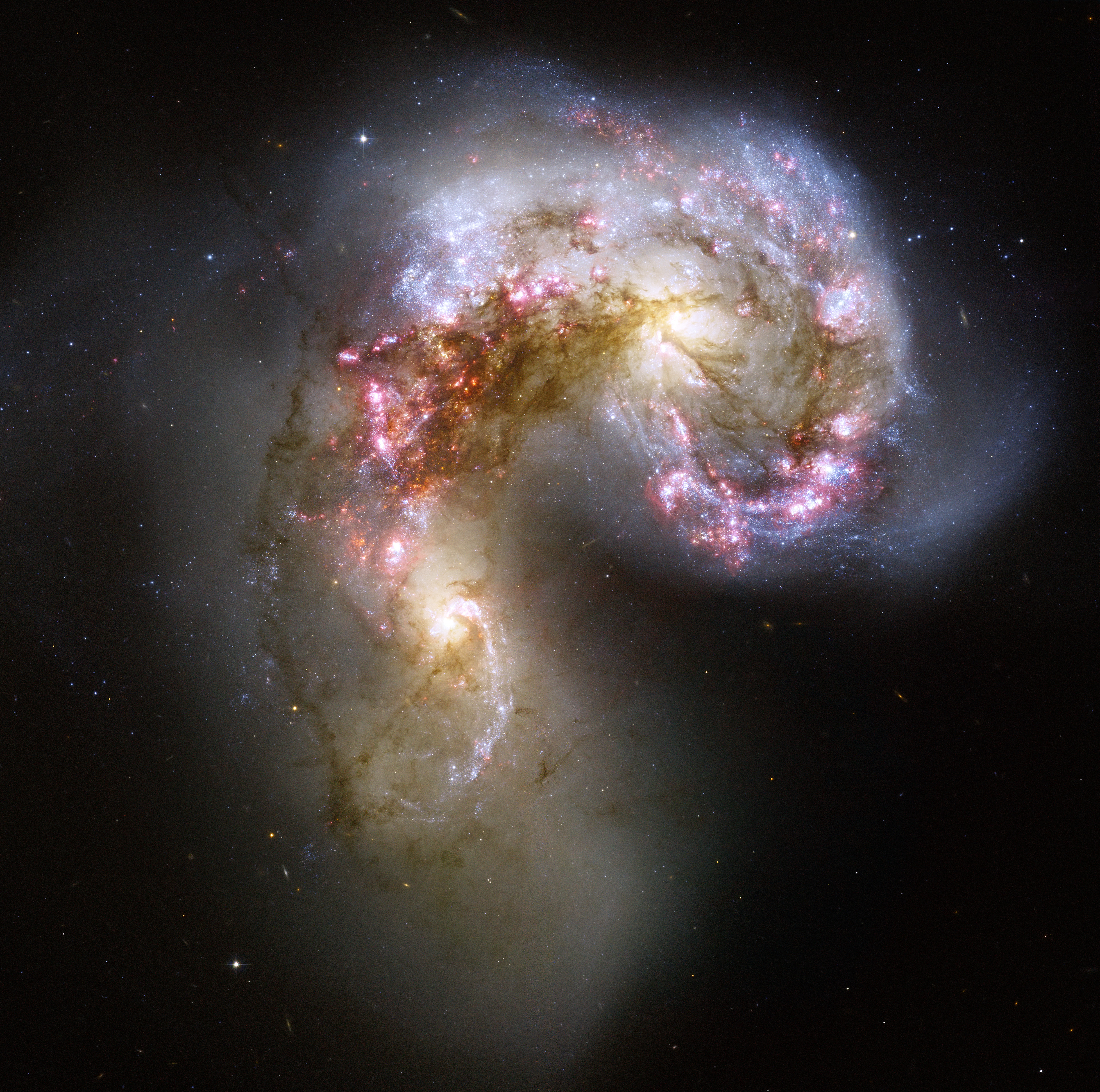
Antennae Galaxies
The Antennae Galaxies are a pair of interacting spiral galaxies caught in the process of merging — one of the nearest and most studied examples of a galaxy collision in progress. The name comes from the pair’s long tidal tails, visible in wide-field images, which curve outward like insect antennae.
The two galaxies, which began interacting roughly 1.2 billion years ago, are currently in the most violent phase of their merger. The collision has triggered an extraordinary burst of star formation — billions of stars are being born in dense clusters in the overlap region between the two galaxies, shown in the Hubble image as bright blue knots. Some of these “super star clusters” are 100 times more massive than typical young clusters in the Milky Way.
The bright orange cores of each original galaxy are surrounded by older stellar populations. The blue regions scattered throughout are sites of active star formation; pink regions mark giant HII nebulae ionized by the newly formed massive stars.
The merger will eventually produce a single elliptical galaxy. The process, including the final coalescence, is expected to take approximately 400 million more years. The Antennae provide a template for understanding the Milky Way–Andromeda merger billions of years from now.