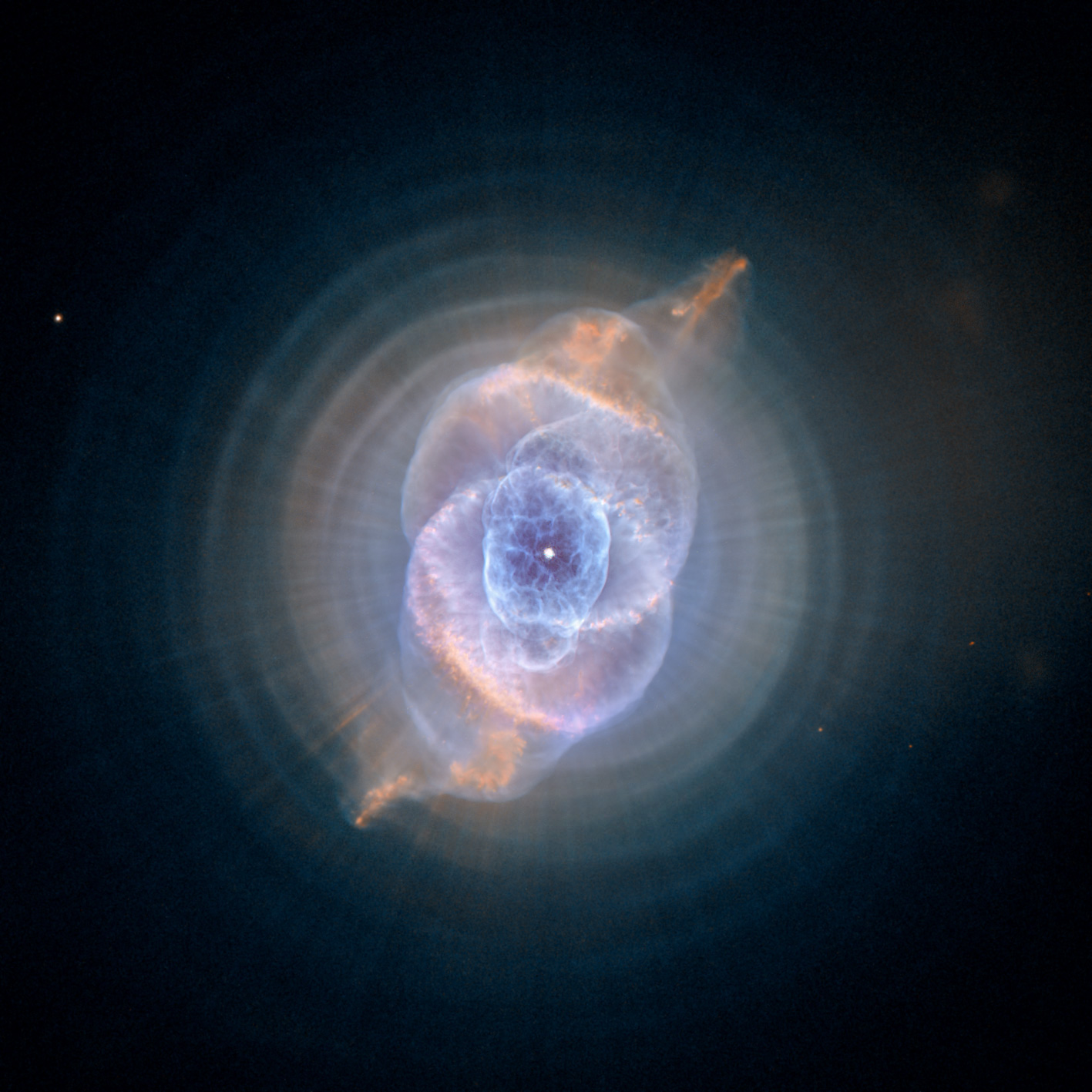
Cat's Eye Nebula
The Cat’s Eye Nebula is one of the structurally most complex planetary nebulae known. Its layered, asymmetric structure reveals a rich and episodic mass-loss history from its central star. Discovered by William Herschel in 1786, it was the first planetary nebula to have its spectrum analyzed.
The central blue-green region is extremely hot ionized gas, heated by the central white dwarf to temperatures exceeding 10,000 K. Around it, nested shells trace successive ejection events over tens of thousands of years, each representing a different phase in the star’s shedding of its outer layers.
The complex structure — jets, bubbles, and concentric rings — suggests the dying star may be in a binary system. A companion star would explain the asymmetries: its gravitational influence could deflect the wind from the primary star and produce the observed jets and point-symmetric features.
The outer halo, visible only in deep exposures, extends to roughly half a light-year and shows earlier ejection events. The variations in brightness and structure between successive shells indicate the mass-loss rate was not constant but occurred in discrete episodes.